
Project management in the age of collective intelligence
1. Why project management Is still too complex
Projects have never been so numerous. Digital transformation, continuous improvement, innovation, compliance, operational performance… today, every organization is running dozens, sometimes hundreds of projects in parallel.
And yet, despite this omnipresence, project management is still too often perceived as a constraint rather than a lever. Too heavy for teams, too opaque for managers, too time-consuming for PMOs and organizations as a whole.
The field paradox :
We have never had so many tools to manage projects and yet teams have never struggled so much to maintain a clear, shared view of what is really happening:
Project plans live in one tool, meetings in another, decisions are written in meeting minutes, scattered across files, actions are tracked in separate tables, problems are analyzed elsewhere and lessons learned are rarely reused.
Each element exists, but rarely in the same place, rarely at the same time, and rarely connected to the others, the result
- Information is fragmented
- Decisions are hard to retrieve
- Actions get lost over time
- Teams spend more time reconstructing the project story than moving it forward
The issue is not the methodology, it is not team commitment either. The real problem lies in the lack of connection between everything that truly brings a project to life on a daily basis, the key question is no longer: How can we manage projects better?, but rather: How can we restore coherence and reconnect everything that makes a project live and evolve every day?
2. A project Is not a schedule, It Is a living system
A project is not just a sequence of tasks to be executed in a predefined order, it is a living system shaped by human interactions, collective decisions, unforeseen events, trade-offs, and continuous learning. A project truly progresses when:
- Teams communicate effectively
- Decisions are understood, shared, and owned
- Deviations are analyzed
- Problems are addressed at their root
- Learnings are captured and reused
In other words, projects are not driven by dates and deliverables alone, but by:
- Effective meetings
- Shared visibility
- The ability to adapt quickly
- A collective memory that grows over time
This is precisely why many “well-planned” projects still derail, not because the plan was wrong, but because the project was never designed as a continuous learning loop. In a constantly evolving environment, a high-performing project is not the one that blindly follows its initial plan, but the one that knows how to:
- Clearly observe what is really happening
- Adjust actions quickly
- Integrate field feedback
- Turn every difficulty into an opportunity for improvement
This vision of the project as a living organism, rather than a static object, opens the door to a more modern, more human, and more effective approach to project management, and this is exactly what well-designed digital solutions now make possible.
3. Centralization Is not enough : real value comes from connection

To address information fragmentation, many organizations take a logical first step : centralization. They centralize documents, project plans, meeting minutes, indicators, creating a single-entry point and a shared repository. This step is necessary, but far from sufficient, centralizing without connecting often means moving the problem rather than solving it, information is stored in one place, but elements still operate in parallel, without real interaction.
- A project plan exists, but it does not “know” what was discussed in meetings.
- A decision is made, but it does not automatically translate into actions.
- A problem is analyzed, but its causes are not linked to indicators.
- A lesson learned is documented, but it does not feed ongoing or future projects.
Information is available, but not alive, this is where interconnection changes everything. Connecting is not about adding hyperlinks between digital objects, it is about creating logical continuity between the key moments of a project:
- What we decide
- What we do
- What we observe
- What we resolve
- What we learn
When elements are interconnected, a decision made in a meeting instantly becomes a tracked action. A deviation naturally triggers a problem-solving process. Corrective actions feed project steering, and lessons learned become part of the organization’s collective memory.
Project management stops being a series of disconnected events and becomes a coherent flow where every piece of information has a real impact. This powerful duo, centralize to provide visibility, connect to create meaning, is where true transformation lies. You no longer manage isolated objects, but a global system, you no longer endure projects, you continuously evolve them and most importantly, the intelligence produced by teams is no longer lost: it circulates, grows, and is transmitted. This is how project management moves from being merely “tooled” to being truly high-performing and learning-driven.
4. Attunea: when centralization and connection become reality
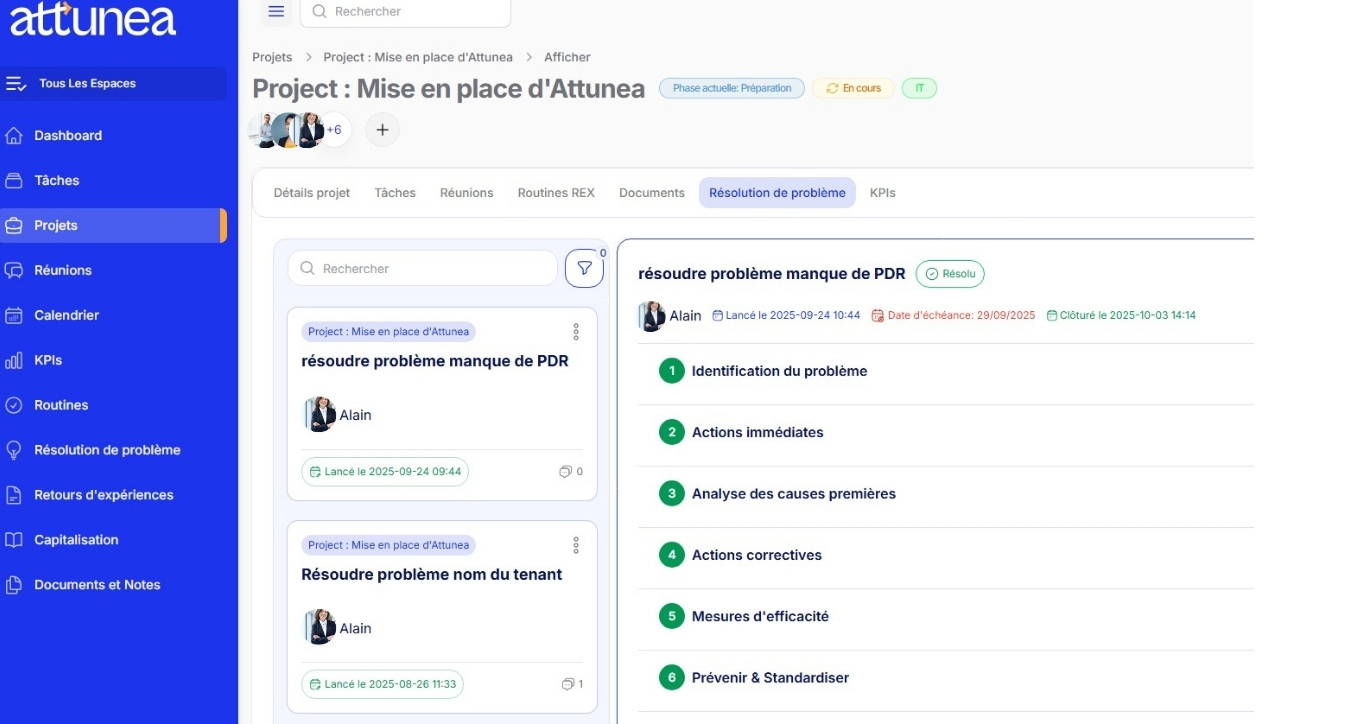
If centralization is a first response, and connection a necessity, the next question is obvious : How can this connection live day to day, without adding complexity for teams?
This is exactly where Attunea makes sense, attunea was not designed as yet another project management tool, but as a platform built to naturally connect all the elements that make up a project. Not by adding layers, but by linking existing practices within a single, coherent, and simple environment.
In Attunea, centralization is never static, project plans, meetings, decisions, actions, indicators, problems, and lessons learned do not merely coexist, they continuously interact.
Project management is no longer an isolated module, but an integrated component of a unified performance management system.
Within a single project space, teams find:
- Project plans
- Follow-up meetings
- Decisions and actions
- Indicators
- Problems and their resolution
- Lessons learned (LL)
- Everything is connected. Nothing is duplicated. And above all, every element feeds the others.
This continuity fundamentally transforms how projects are managed. Teams no longer wonder where to find or store information, nor how to make it circulate, the system does it for them, seamlessly and intuitively.
As a result, Attunea naturally ensures:
- Decision traceability
- Action consistency
- Management visibility
- Organizational learning
Project management stops being a separate discipline and becomes a natural part of everyday operations, serving collective performance and continuous improvement.
5. Project meetings: from a burden to a steering engine
In real-life projects, everything often happens in meetings, this is where teams share progress, arbitrate, decide, and adjust, yet in many organizations, project meetings remain disconnected from actual project steering, Discussions happen, but decisions take time to turn into actions, minutes pile up, decisions fade, and the same topics reappear meeting after meeting.
With Attunea, project meetings regain their central role, each meeting is managed directly within the project space and linked to its objectives, indicators, and actions. Nothing is discussed out of context, the data is already there, visible and shared.
Decisions become immediately traceable, actions are automatically integrated into the project plan, assigned, and tracked over time, identified blockers naturally feed the next steps of project steering. Meetings are no longer just moments of discussion, they become powerful levers for alignment and collective progress, each meeting prepares the next one, and each decision moves the project forward.
6. Solving problems without breaking project momentum
No project moves forward without obstacles, the difference between a stalled project and a progressing one rarely lies in the absence of problems, but in the ability to address them effectively, too often, problems are handled outside the project:
- In separate files
- In dedicated meetings
- Informally, with little capitalization
- And without a structured methodology
The result ? Symptoms are corrected, but root causes remain. In Attunea, problem-solving naturally fits into the continuity of project steering, deviations observed in indicators or meetings become analysis points, teams structure their thinking using proven methods: 5 Whys, Ishikawa, root cause analysis, corrective action plans, and more.
Most importantly, these analyses are never isolated, they are automatically linked to the relevant project, decisions, and actions. Each resolved problem becomes a learning opportunity. Each corrective action improves the current project, and future ones. Projects no longer stop in the face of difficulties; they evolve with them.
This seamless integration of problem-solving into the project space, without breaking momentum, is what makes project management truly robust and sustainable.
7. Finally capitalizing on lessons learned
How many projects end with the same promise : “Next time, we’ll do better.” Lessons learned are often well intentioned, but rarely effective, conducted too late, stored in unread documents, or limited to a few insiders, they struggle to influence real projects, yet every project generates tremendous value:
- Relevant decisions
- Effective adjustments
- Instructive mistakes
- Proven field solutions
In Attunea, lessons learned are not a separate phase or a formal end-of-project exercise, they are embedded throughout the project lifecycle, within meetings, problem-solving, and actions.
Learnings are connected to:
- The decisions that generated them
- The context in which they emerged
- The actions that improved the situation
This connection transforms lessons learned into operational, accessible, and reusable knowledge. When launching a new project, teams draw from real experiences, avoid known pitfalls, and accelerate decision-making, projects stop being isolated initiatives and become part of a continuous collective learning journey, where each experience strengthens organizational maturity. With Attunea, knowledge no longer disappears between projects. It circulates, grows, and becomes a lasting performance lever.
8. Project management as a driver of continuous improvement
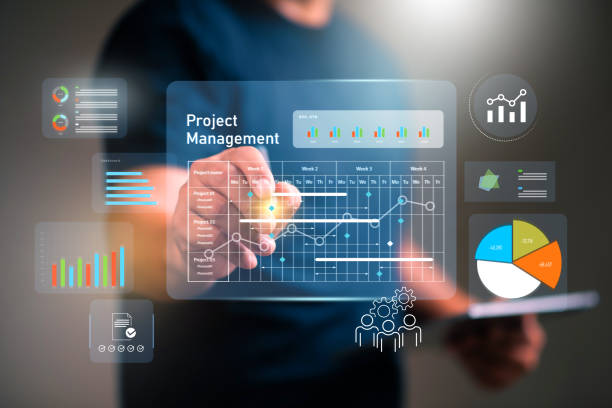
When plans, meetings, decisions, problems, and lessons learned are connected and managed in a single space, project management changes nature, it is no longer just about delivering on time, it becomes a structural driver of continuous improvement, each project becomes a learning loop: plan, act, observe, adjust. The PDCA cycle is no longer theoretical, it is lived daily.
In Attunea, this dynamic happens naturally, projects build on past learnings, evolve through ongoing adjustments, and enrich the organization for the future. Teams gain clarity and autonomy, managers benefit from a shared, factual, cross-functional view. And the organization progresses coherently, without disconnects between strategy, steering, and the field.
In a world of increasingly transversal, uncertain, and interconnected projects, the ability to learn continuously makes all the difference, it is no longer just projects that succeed, the entire organization grows in maturity, agility, and sustainable performance.
Conclusion: when projects stop being isolated
Modern project management is no longer just about meeting deadlines, it is about coherence, learning, and collective performance. When projects are isolated, effort is repeated, experience is lost, and managers’ mental load and stress increase, caught between plans, meetings, reports, urgencies, and constant trade-offs.
When projects are connected, every action, decision, and difficulty contribute to clarity, information flows, priorities align, and adjustments become simpler and more serene.
With Attunea, projects are no longer isolated initiatives to manage, they become living loops of continuous improvement, where meetings, decisions, problems, and lessons learned connect naturally and effortlessly. It is not just a new way to manage projects, it is a more fluid, more human, and more sustainable way to grow the organization, project after project
Lead your projects with clarity and peace of mind
Attunea centralizes and connects plans, meetings, decisions, problems, and lessons learned in a single space, delivering clear visibility, aligned teams, and a reduced mental load for both managers and teams